Domains and model levels
Anaqsim uses one separate two-dimensional model for each subdomain. In Anaqsim, subdomain input is entered in the Domains data tables (Domain in Anaqsim is short for subdomain). In each subdomain model, the resistance to vertical flow is neglected and the head is independent of elevation within the subdomain (Dupuit assumption). Resistance to vertical flow and three-dimensional flow are modeled by using multiple levels with vertical leakage between levels. To illustrate how subdomains and model levels are implemented in Anaqsim, we will go through several examples, starting from simple and working toward complex.
Simple one-level, one-domain model
The simplest model would be one level (two-dimensional), and only one subdomain (homogeneous). A plan view of such a simple model is shown below.
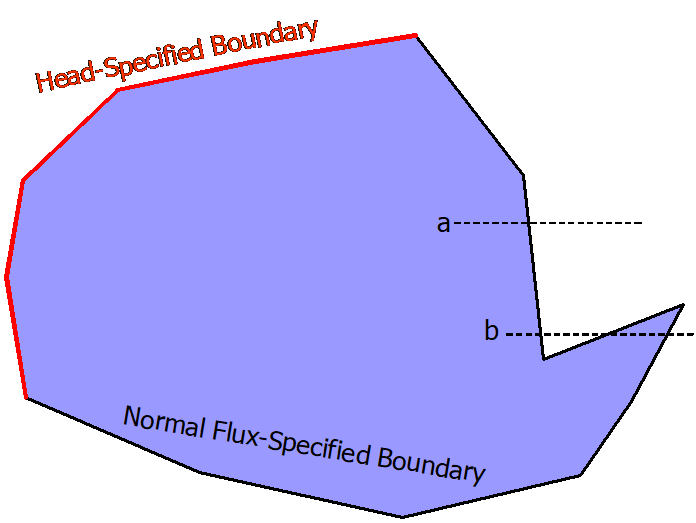
The properties of the subdomain (hydraulic conductivity, porosity, elevations, etc) are defined with the Domains input. The spatial extent of the subdomain (blue) is defined by the line boundaries that are listed as being on the external perimeter of the subdomain. This is different from TWODAN or other analytic element programs where one domain is the infinite "background" domain, and a heterogeneity (domain) lies inside a polygon dedicated to defining the heterogeneity boundary. The scheme in Anaqsim allows different kinds of boundaries to define the limits of a domain, which is much more flexible. In the simple model shown above, there are two line boundaries that form the external boundary of the domain: one that is head-specified (red) and one that is normal-flux specified (black).
Which points lie inside a domain?
The algorithm that determines what points lie inside the domain works as follows: a point is inside the subdomain if going in the positive x direction (right) from the point, you cross a boundary of the domain an odd number of times. For most points inside the domain, there is only one boundary crossing in the positive x direction (like "a" above), but it is possible to have three or more crossings (like "b" above).
In general, subdomain boundaries should combine to form a perfectly closed polygon, with exactly matching points where the line boundary end/start points meet. If the line boundaries defining the boundary of the domain have a gap, it can lead to erroneous definitions of domain areas and odd model results. The boundary gap in the example below allows a strip to the left of the gap (white) that is technically not inside that domain (blue); points in this strip have zero boundary crossings to the right.
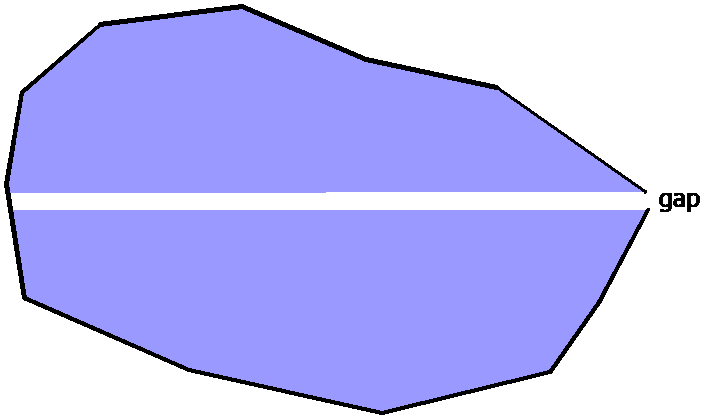
A similar result happens if there is overlap in the location of two end/start points; where they overlap, the algorithm sees two crossings in the positive x direction.
Heterogeneous one-level models
Now consider a model that is still one level (two-dimensional), but is heterogeneous with three subdomains, blue, yellow, and green (below). This example has three types of line boundaries which are labeled: head-specified (hs), normal flux-specified (nfs), and inter-domain (id). Each different line boundary is shown in a different color and is labeled hs, nfs, or id.
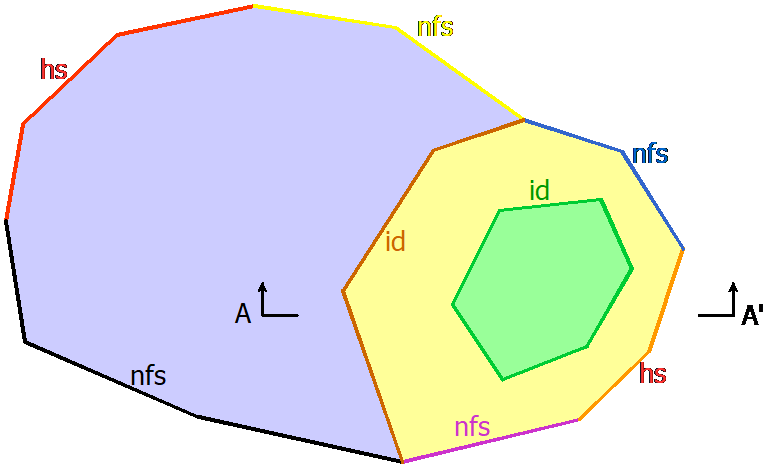
At all the common intersections where two or more line boundaries meet, the coordinates of the end points must match exactly, so that each subdomain region is defined without gaps or errors.
Along inter-domain boundaries, you specify which domain lies to the left and which domain lies to the right. For example, if the coordinates of the inter-domain boundary between blue and yellow are listed in order from bottom to top, blue is to the left and yellow is to the right. If the coordinates of the boundary between yellow and green is defined in clockwise order, yellow is to the left and green is to the right.
See also Left and right on line boundaries.
Multi-level (3D) areas
Now imagine that the model shown above is a single level in the blue and yellow areas (two-dimensional), but has four levels in the green area (three-dimensional). A vertical cross section along A-A' for such a model is shown below.
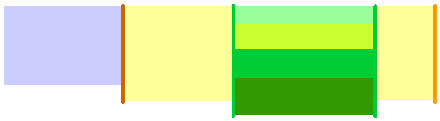
The convention for naming levels in Anaqsim is to start at level 1 at the top and increase the level numbers with depth in a multi-level stack. In the green area, level 1 is at the top and level 4 is at the bottom. Anaqsim assumes that there is vertical leakage between subdomains that exist in the same area but at different vertical levels. It is possible to skip a level number in a stack of subdomains; for example, the green area in the above section could have domains with levels 2, 3, 5 and 6 rather than levels 1, 2, 3 and 4. Anaqsim finds the next domains above and below, no matter what the level numbers are and even if there are gaps in level numbers. This is helpful in cases with complex layering schemes such as where a domain has limited extent compared to the domains above and/or below it. The resistance to vertical flow between levels is computed based on the vertical hydraulic conductivities and thicknesses specified for the domains involved.
The brown inter-domain boundary separating the blue and yellow subdomains would have one subdomain on the left (blue) and one on the right (yellow). The green inter-domain boundary separating the yellow and green subdomains would have one subdomain on the left (yellow) and four on the right (shades of green), assuming that boundary is defined with coordinates in clockwise order. Across inter-domain boundaries, there is approximate continuity of head and approximate continuity of the normal component of discharge. This approximation is discussed more under Inter-domain boundaries. Interdomain boundaries can connect subdomains in different levels (e.g. level 1 on one side and levels 2 and 3 on the other).