Inter-domain boundaries
At the inter-domain boundaries, two different boundary conditions are enforced by Anaqsim.
Continuity of head
First, heads are matched across the boundary at specific points in all subdomains that intersect the boundary. For example with the green inter-domain boundary shown in the figures below, heads are matched in the yellow domain and the four green domains at control points along the boundary.
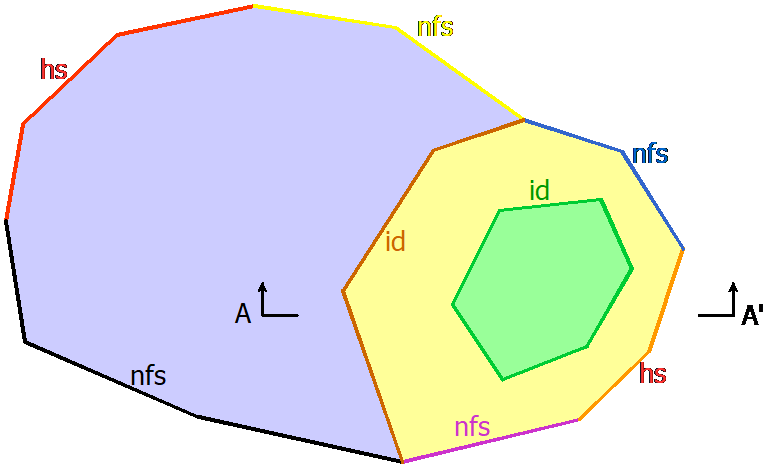

Plan view (above) and section view (below) of a multi-domain model.
Continuity of normal discharge
Secondly the normal component of discharge is matched across line segments on the inter-domain boundary. For the green inter-domain boundary, this means that the sum of the normal components of discharge in the four green subdomains must equal the normal component of discharge in the yellow subdomain. This condition is enforced across intervals on a line segment. If each line segment on the inter-domain boundary has \(n\) parameters, then the condition is enforced across \(n\) intervals per line segment.
Checking accuracy
To check whether a line boundary has enough parameters, select  Plot check on its data-table row. The Graph panel shows how closely the solution approximates the boundary condition. If you don't have satisfactory accuracy, you can either (1) specify more parameters (control points) per boundary line segment, and/or (2) break a long boundary line segment into multiple, shorter segments.
Multi-level sides
One consequence of the head-matching condition is that there will be no vertical hydraulic gradient between different levels on the multi-level side of an inter-domain boundary. This is consistent with the fact that there is no vertical resistance to flow accounted for on the single-level side of an inter-domain boundary. Because of this, it is not appropriate to use one inter-domain boundary with multiple levels on both sides of the boundary; doing so would remove vertical head gradients at the boundary, which defeats the purpose of having multiple levels.
With inter-domain boundaries, there should generally be just one domain (level) on one of the two sides of the boundary. Anaqsim checks the input and gives a warning if there are two or more levels on both sides of an inter-domain boundary. To explain why, consider the case illustrated below, with two levels on the yellow side of the inter-domain boundary(s) and four on the green side.

If there was just one inter-domain boundary there, it would be as though an infinitely conductive thin vertical boundary were inserted between the yellow side and the green side, and heads would match in all six domains that meet there, meaning there can be no vertical head gradient on either side of the boundary. The total normal component of discharge would match (total normal discharge in the two yellow domains would match the total normal discharge of the four green domains), but that normal discharge may be distributed oddly between different levels (e.g. a lot of flow from the lower yellow level going into the uppermost green level). A better solution would be to use two inter-domain boundaries:
- one with the lower yellow domain on one side and the two lowest green domains on the other, and
- one with the upper yellow domain on one side and the upper one or two green domains on the other.
This way, there can be vertical gradients between the yellow/green interface, and upper-level flows are matched with each other and lower-level flows are matched with each other.